

Eye On the Sky
By Brookings County Emergency Management Director Bob Hill
10-09-2026
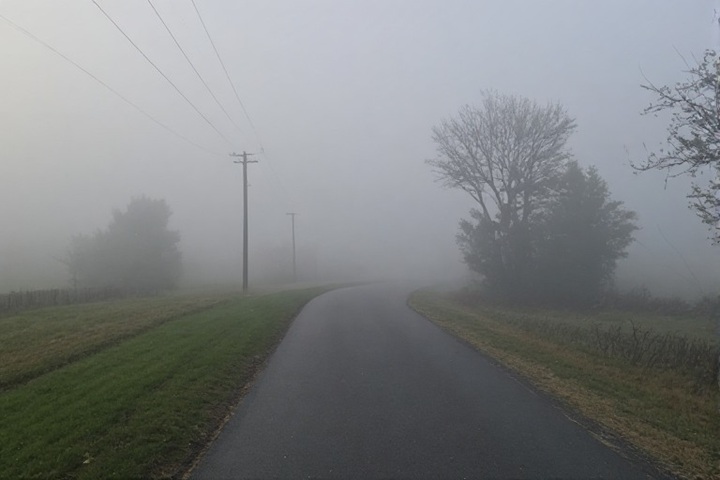
As you may have noticed, fall is not in a hurry to start quite yet. The farmers are heading out to the fields early in the mornings, and the harvest is getting in full swing. This time of the year is a good time to remember that fog can form during the mornings when the temperatures fluctuate.
Often, when a Fog Advisory is issued, it is during the overnight hours. Messages received on social media or through texts may be delayed in getting out. One needs to use their visual senses and, if it is foggy outside, turn their headlights on. Do not rely on automatic headlights; they have been known to only turn on driving lights and not headlights during foggy conditions.
Driving in fog can be dangerous, with over 38,000 vehicle crashes occurring each year. Of those crashes, over 600 people are killed, and more than 16,300 people are injured annually. Be on the lookout for sudden changes in visibility, and if reduced visibilities are encountered while driving, do not change lanes or pass other vehicles unless absolutely necessary. Slow down, turn off cruise control, reduce “in-vehicle” distractions, and be sure that you can stop within the distance that you can see. Some other information from the NWS is if you must drive in foggy conditions, keep the following safety tips in mind:
• Slow down and allow extra time to reach your destination.
• Make your vehicle visible to others both ahead of you and behind you by using your low-beam headlights since this means your taillights will also be on. Use fog lights if you have them.
• Never use your high-beam lights. Using high beam lights causes glare, making it more difficult for you to see what’s ahead of you on the road.
• Leave plenty of distance between you and the vehicle in front of you to account for sudden stops or changes in the traffic pattern.
• To ensure you are staying in the proper lane, follow the lines on the road with your eyes.
• In extremely dense fog where visibility is near zero, the best course of action is to first turn on your hazard lights, then simply pull into a safe location such as a parking lot of a local business and stop.
• If there is no parking lot or driveway to pull into, pull your vehicle off to the side of the road as far as possible. Once you come to a stop, turn off all lights except your hazard flashing lights, set the emergency brake, and take your foot off of the brake pedal to be sure the taillights are not illuminated so that other drivers don’t mistakenly run into you.
The NWS does send out their advisories and warnings when the conditions warrant it. A Dense Fog Advisory is issued by your local National Weather Service office when widespread dense fog develops. When this happens, visibilities frequently drop to one-quarter of a mile or less. These conditions make travel difficult. Take extra caution when on the road or avoid driving if possible.
A Freezing Fog Advisory is issued by your local National Weather Service office when fog develops, and surface temperatures are at or below freezing. The tiny liquid droplets in the fog can freeze instantly to any surface, including vehicles and road surfaces.
Freezing fog makes driving, boating, flying and other forms of transportation particularly hazardous. Visibility typically drops to be at or below 1 mile.
The National Weather Service (NWS) has streamlined its process when dealing with cold weather. What Do You Need to Know about HAZARD SIMPLIFICATION? Or to phrase it another way, What Does NWS Consolidation Mean for the Extreme Cold, Freeze, and Wind Chill Product Suites?
As part of the ongoing National Weather Service (NWS) Hazard Simplification Project, the NWS is acting upon data collected during public and partner engagements, surveys, and social science research leading to the consolidation of Wind Chill and Extreme Cold products and Freeze and Hard Freeze Products.
The new NWS Cold Product Suite will allow NWS to communicate that cold is dangerous with or without wind. Wind chill will not go away, although emphasis will be placed on “cold is cold” for public safety.
Consolidation of NWS Freeze and Hard Freeze products into one streamlined Freeze Watch/ Warning with enhanced language for hard freeze conditions as needed will simplify and improve messaging and service delivery. The scope of the NWS Frost/Freeze services is focused on vegetation and agriculture considering growing season, impacts, and precautionary/preparedness actions.
What are the benefits of HAZARD SIMPLIFICATION?
• It streamlines the forecast process
• It unifies terms across the United States
• It simplifies messaging by using a single product type for Extreme Cold and Wind Chill
• It produces simplified messaging by using a single product for Freeze and Hard Freeze
• It can message that cold is dangerous with or without wind
• And finally, it can offer clearer Watch/Warning/ Advisory maps.
Enjoy this nice weather and remember to Keep an Eye on the Sky.
— Bob the EM