

BROOKINGS, S.D. — Aug. 24, 2026 — A South Dakotan whose work is credited with saving more than 25 million people from starvation will be honored at an upcoming art dedication.
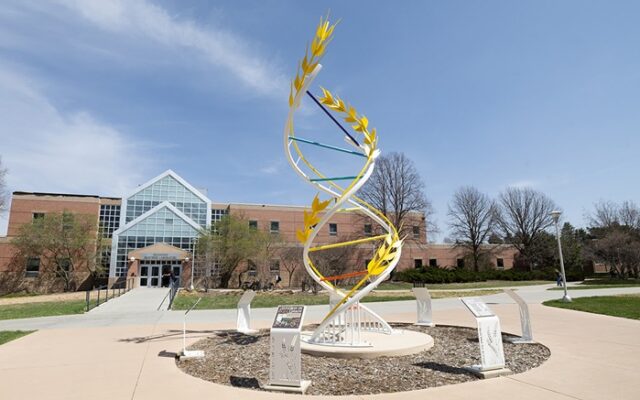
Edgar McFadden, breeder of the aptly named wheat variety “Hope,” will be honored at a public ceremony and reception on Saturday, Aug. 29. The ceremony will celebrate the dedication of a new art sculpture, H.O.P.E. a Helix of Resilience: The Life, Journey & Legacy of Edgar S. McFadden.
“We honor Edgar McFadden and give our campus a lasting way to recognize an SDSU pioneer whose vision changed agriculture worldwide,” said Joe Cassady, SD Corn Endowed Dean of the SDSU College of Agriculture, Food and Environmental Sciences. “The sculpture will invite students, faculty, staff and visitors to reflect on how one person’s perseverance and discovery can create an enduring legacy of hope.”
Event speakers will include South Dakota Gov. Larry Rhoden, SDSU President Barry Dunn, Jon Kleinjan of the South Dakota Wheat Commission, Jennifer Scharpe of the South Dakota Wheat Growers Association, sculptor Reinaldo Correa and Dean Cassady.
McFadden graduated from State College (now South Dakota State University) and went on to become the school’s official plant breeder. When the U.S. Department of Agriculture cut funding to his position in 1920, he mortgaged his farm to continue his work to develop a rust-resistant wheat variety to help South Dakota farmers. In 1925 he developed a wheat variety that, while not the highest yielding, was resistant to both stem and leaf rust. McFadden named this new variety Hope.
In the decade that followed, other breeders made Hope hybrids that were higher yielding but kept the rust resistance McFadden had worked so hard to achieve. By the late 1930s, it was estimated that almost all of California’s wheat fields were planted with varieties containing Hope genetics. Many historians credit Hope with helping fuel the Allies victory in World War II, and Reader’s Digest estimated Hope prevented starvation for more than 25 million people and saved American farmers $400 million in lost yields.
“Edgar McFadden transformed a boyhood determination to defeat the wheat disease known as ‘rust’ into Hope — a rust-resistant wheat that changed the world,” said Cassady, chair of the McFadden Endowment Board. “His legacy reflects the power of persistence, scientific curiosity and an unwavering commitment to serving South Dakota’s farmers.”
Even today, many of the most widely planted wheat varieties contain genetic material from Hope, carrying on McFadden’s legacy for more than 100 years.
Artist Reinaldo Correa of Reinaldo Art Studio was commissioned to create an art piece honoring McFadden. Last spring, H.O.P.E. a Helix of Resilience: The Life, Journey & Legacy of Edgar S. McFadden was installed by Correa and university Facilities and Services, with informative placards added over the summer to share the humble wheat breeder’s story.
The sculpture will be dedicated before SDSU’s first home football game of the season. The ceremony will begin at 3:30 p.m. between the Edgar S. McFadden Biostress Lab building and the Raven Precision Agriculture Center and will be followed by a reception in the SD Corn Gallery inside Raven. All are welcome to attend.
More information about McFadden can be found in the publication links below:
Information in this article and the articles linked above was uncovered thanks to the hard work of Kevin Kephart, former vice president of research for SDSU.
About South Dakota State University
Founded in 1881, South Dakota State University is the state’s Morrill Act land-grant institution as well as its largest, most comprehensive school of higher education. SDSU confers degrees from seven different colleges representing more than 230 majors, minors and specializations. The institution also offers 39 master’s degree programs, 17 Ph.D. and two professional programs.
The work of the university is carried out on a residential campus in Brookings, at sites in Sioux Falls, Pierre and Rapid City, and through Extension offices and Agricultural Experiment Station research sites across the state. SDSU’s research expenditures for the 2025 fiscal year were more than $94 million. SDSU has a Doctoral University: High Research Activity designation on The Carnegie Classification of Institutions of Higher Education.
For more information: SDSU News • www.sdstate.edu
— From SDSU University Marketing and Communications