

BROOKINGS (10-13-26) — It’s a first-of-its-kind scholarship at South Dakota State University, and its roots came from a little girl’s childhood on a farmhouse near Tripp, South Dakota.
Diane Reese has always been motivated to serve the hurt people (and animals) in her life.
“I’ve always been the healer. It was the newborn kittens, the dog that got hurt, the sheep that got out — that kind of thing. It started as a farm girl, and I have been caring for others ever since,” she said.
Reese has founded a new scholarship at SDSU for nursing students pursuing a degree in behavioral healthcare, a first for the university.
She chose SDSU because all four of her children are Jackrabbits, but also because of its positive reputation.
“It’s the kind of school that I find myself thinking, ‘Oh yeah, give them a lot of hurrahs because SDSU does a lot of good things,’” Reese said.
The reason she chose to target psychiatric care nursing is that it’s where Reese herself, earned 36 years of hurrahs.
Serving the overlooked
Reese graduated from Sacred Heart School of Nursing in Yankton in 1961.
From 1961 to 1997, she worked with people with psychiatric illnesses in Yankton, at the State Hospital, now known as the South Dakota Human Services Center. She was the first female nurse allowed to work with male patients at the hospital early in her career.
“Initially, there would be a man on each side of me, and they would escort me through the wing where male patients were being housed. And when I say housed, that was exactly what was happening,” Reese said.
She described patients listlessly sitting around the wing, with limited to no contact or stimulation.
“There was very little human communication going on. As a nurse, when I got exposed to that, that was really a painful thing. These people were so overlooked and they deserved better treatment,” she said.
In the early ’60s, patients with mental illnesses were often locked away, or hidden, from the public. There was a bevy of stigma around these illnesses, the care required, and the challenges these patients faced. Additional resources were also sorely needed.
“People with mental health issues were tucked away, so people didn’t want to admit that there was any kind of problem. If you had appendicitis, that’s fine. But if you had depression, schizophrenia or a mood disorder, we’re not going to talk about that.”
Throughout her career, Reese not only talked about it, but she was a strong advocate for the patients and for the nurses that were invested in caring for them. She provided a strong voice, all the while fighting to change how society approached these patients.
The new scholarship is another way she’s bringing these issues to the forefront.
Better behavioral health, stronger communities
Robin Arends is the assistant academic dean for cooperative programs for SDSU’s College of Nursing. She worked in primary care before joining SDSU’s teaching faculty.
“Behavioral health can have a tremendous impact. You can have patients who can’t get out of bed or function. Through assessment, treatment and working with the patient, they can achieve their goals,” she said.
Arends was a student in the college’s first psychiatric mental health nurse practitioner postgraduate certificate cohort. She pursued the certificate, earning it in 2021, after working in primary care for several years.
“I went back for my postgraduate certificate after realizing how much mental health influenced patients’ lives, yet a lot of patients didn’t have access to mental healthcare or had a long wait to get it,” she said.
Arends stressed that mental health doesn’t just impact individual patients and healthcare providers.
“A community is made up of individual people, so if you have individuals who are suffering from mental health conditions, the community is affected. That’s especially true in rural communities where everyone is so intertwined and interconnected,” she said.
Better mental healthcare access for an individual means stronger communities. Scholarships like Reese’s have far-reaching impacts by uplifting an individual nurse — a nurse like Jordyn VanVickle, who is one of the first recipients of the scholarship.
Rural nurse benefits from scholarship
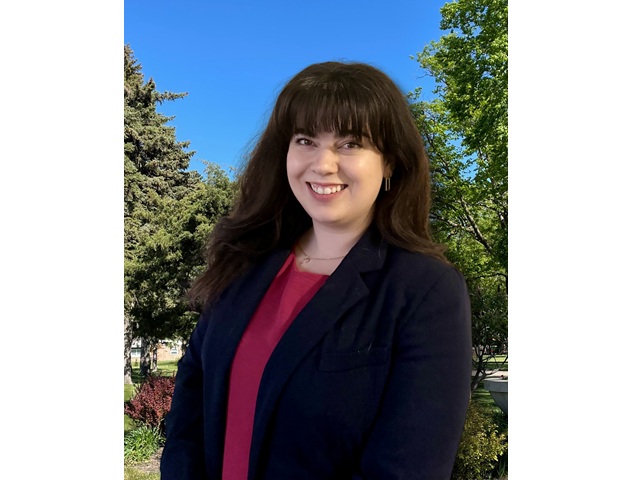
VanVickle is an SDSU graduate nursing student from Pillager, Minnesota. She got her undergraduate nursing degree in 2024 from SDSU and will get her Doctor of Nursing Practice in the psychiatric mental health track in May 2029.
She’s getting her degree online while working in the rural town of Maryville, Missouri, as a registered nurse on a behavioral health unit. She wants to stay in mental healthcare in a rural setting after graduating. Reese’s scholarship is helping her do that.
“It takes a huge load off a student’s back, and it’s an honor to benefit from someone’s generosity,” she said.
Reese was once in VanVickle’s shoes. She said her 36-year career was fulfilling and feels confident that she and her fellow nurses made a difference.
Yankton’s Citizen of the Year
Just ask around, and you will likely hear that, yes, Reese did make a difference. The first floor of the Avera Behavioral Health Hospital in Sioux Falls is named in her honor.
And in 2022, the city of Yankton recognized Diane Reese as Citizen of the Year. Why?
“My two cats must have voted me in,” Reese joked.
Her son, former mayor of Sioux Falls Mike Huether, provided stronger justification. He said the South Dakota Human Services Center has had a profound impact on Yankton, and it was Reese’s impact on patients, fellow employees there and the community of Yankton over her lifetime that made the difference.
On top of that, Reese and her serving mindset have been involved in many local nonprofits and at her church.
“Mom’s not going to say this, but when she goes out in public, about every other person says, ‘How are you doing, Diane?’ because of the impact she’s made on others,” he said.
“I don’t want people, animals, or anything to be hurting,” Reese said. “That is my purpose, I guess. I feel like God put me on this Earth to make sure I provide help for those in need or weren’t acknowledged as being in need.”
Giving while living
Reese said part of her legacy will be her kids’ legacies. She raised four kids with the same passion for caring for others that she has.
As for the rest of her legacy, she’s not waiting until she passes away to donate to the causes she’s passionate about.
“We call it giving while living,” Huether said.
Reese is not waiting to donate her stewardship dollars to a number of worthy organizations, including the scholarship she set up at SDSU.
“So that it makes an impact when she’s alive, and she can see and experience the difference it’s making now,” her son said.
Reese has received several thank-you cards from students like VanVickle whose education she’s helping support.
Huether said they’re encouraging others to give while they are living.
“Don’t wait to donate your inheritance money. Do it while you’re alive,” he said. “My mom was the first to do a behavioral health nursing scholarship at State, but many more are needed as our country’s mental and behavioral health challenges are enormous. Let’s go Rabbits!”
About South Dakota State University
Founded in 1881, South Dakota State University is the state’s Morrill Act land-grant institution as well as its largest, most comprehensive school of higher education. SDSU confers degrees from seven different colleges representing more than 230 majors, minors and specializations. The institution also offers 39 master’s degree programs, 17 Ph.D. and two professional programs.
The work of the university is carried out on a residential campus in Brookings, at sites in Sioux Falls, Pierre and Rapid City, and through Extension offices and Agricultural Experiment Station research sites across the state. SDSU’s research expenditures for the 2025 fiscal year were more than $94 million. SDSU has a Doctoral University: High Research Activity designation on The Carnegie Classification of Institutions of Higher Education.
For more information: SDSU News • www.sdstate.edu
— From SDSU University Marketing and Communications