


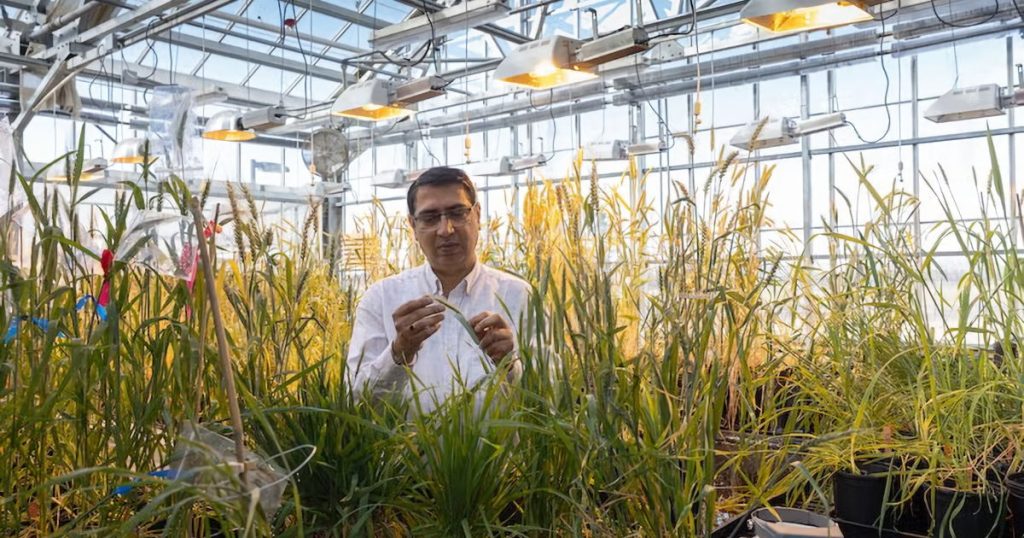
BROOKINGS (11-12-26) — Wheat researchers at South Dakota State University are perfecting an AI-powered web application designed to speed the work of wheat breeders and equip farmers with a more accurate tool for making decisions.
Professor Sunish Sehgal began taking photos in 2022 to develop this AI tool. WheatAI (wheatai.net) was built from smartphone and drone images of winter wheat taken five times between May and July at SDSU research farms near Pierre and Brookings and producer fields in Winner and Hayes.
In 2025, Sehgal, along with Maitiniyazi Maimaitijiang, an assistant professor in the Department of Geography and Geospatial Sciences, started developing a working prototype designed to estimate yield based on various plant characteristics and assess wheat diseases, including those caused by Fusarium, a fungal pathogen that can infect wheat plants and damage kernels.
The project brings together Sehgal’s expertise in wheat breeding and genetics and Maimaitijiang’s expertise in remote sensing, AI and computer vision. Their collaboration aims to make wheat phenotyping faster, accurate, consistent and accessible to researchers and producers.
Working alongside multiple graduate students, Sehgal and Maimaitijiang developed the platform, which can now analyze nine plant characteristics. The team plans to add another 10 to 12 traits to the platform before it is released to the public, tentatively in 2028.
When WheatAI is released at wheatai.net, it will be at a price everyone can afford—free. “Nothing like this exists in the world that is free. We intend to democratize the phenotyping and send it to the last mile so that the farmer and students can use it freely,” Sehgal said.
A game changer for wheat breeders
For wheat breeders, the platform promises to revolutionize the process.
A plant’s genotype, its DNA arrangement, can be sequenced accurately and inexpensively today, Sehgal said. But what is the relationship between the genotype and the phenotype, the different measures of plant growth and productivity?
Traditional phenotyping is a slow process done by hand with a good measure of subjectivity. Graduate students sit at a lab bench counting kernels on the head of a wheat stalk or the tillers in a developing plant. For example, when visually assessing disease severity, different researchers may assign different ratings to the same wheat head, such as a 5 or 7, depending on how they interpret the symptoms.
“However, the camera always looks at it the same. It takes the bias out,” said Sehgal, who was a research scientist at Kansas State before coming to SDSU in 2014.
By using AI-powered image analysis, WheatAI aims to reduce the subjectivity associated with manual measurements while allowing researchers to evaluate much larger numbers of samples in less time.
Another plant characteristic they are looking at is stomatal traits. “Finding something good is always a numbers thing. The more wheat lines we could screen, the higher the chance to find something useful.
“Further, WheatAI would increase accuracy. Which is more accurate, an analysis made with 500 images or one with manual estimation of five stomata? With this technology, it becomes feasible to rapidly process a large number of images and have an accurate analysis within a short period of time,” he said.
A valuable tool for farmers
Beyond wheat breeding, WheatAI also has the potential to provide farmers with practical tools for crop monitoring and management decisions.
Currently, farmers might determine yield potential by manually counting heads per square foot from a few spots in the field. With WheatAI, they could take 10 to 20 photos in a large field, load them into the platform, and quickly obtain an automated analysis of heads per square foot, Sehgal said.
This approach could make crop assessment faster and more consistent, depending on representative sampling and model accuracy.
Putting tools like WheatAI in the hands of producers could allow them to make an earlier and more accurate determination of the fate of a crop — grain production or silage. It could also help them assess Fusarium-damaged kernels in their harvest, Sehgal said.
As the research team continues to expand and refine WheatAI’s capabilities, its long-term goal is to make advanced wheat phenotyping tools accessible to breeders, researchers, students and farmers.
By combining AI with widely available imaging technologies, WheatAI has the potential to improve the efficiency of wheat breeding and improvement, support crop monitoring and help producers make more informed decisions.
About South Dakota State University
Founded in 1881, South Dakota State University is the state’s Morrill Act land-grant institution as well as its largest, most comprehensive school of higher education. SDSU confers degrees from seven different colleges representing more than 230 majors, minors and specializations. The institution also offers 41 master’s degree programs, 19 Ph.D. and two professional programs.
The work of the university is carried out on a residential campus in Brookings, at sites in Sioux Falls, Pierre and Rapid City, and through Extension offices and Agricultural Experiment Station research sites across the state. SDSU’s research expenditures for the 2026 fiscal year were more than $86 million. SDSU has a Doctoral University: High Research Activity designation on The Carnegie Classification of Institutions of Higher Education.
For more information:SDSU News • www.sdstate.edu
— From SDSU University Marketing and Communications