

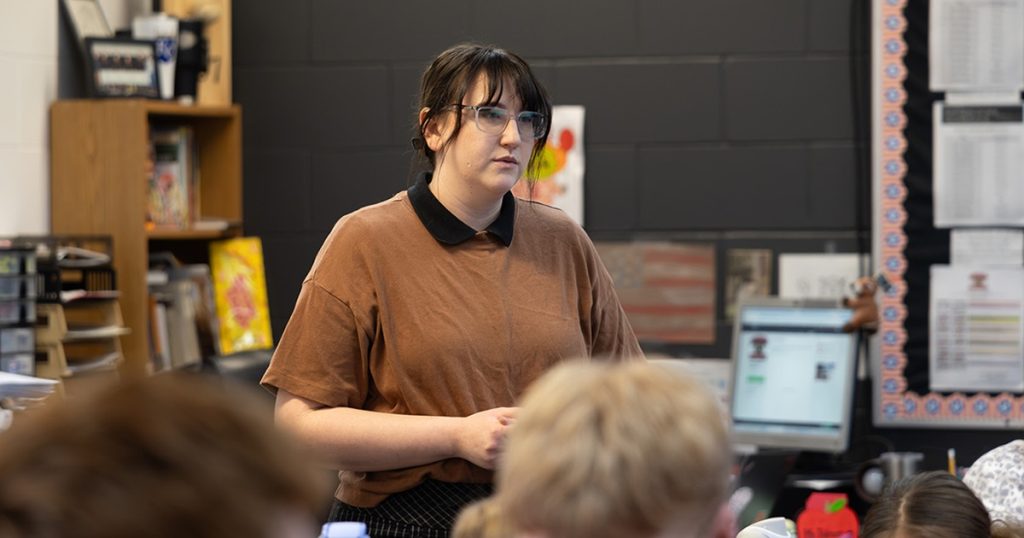
BROOKINGS (11-18-26) — South Dakota State University’s teacher education programs hit record enrollment numbers in fall 2026. The School of Education has enrolled 715 teacher education students this semester, a 19% jump from 2024.
Teacher education is among SDSU’s programs with the highest enrollment. The reasons for the program’s success are multifaceted, according to Anne Karabon, Wendell and Marlys Thompson Director of SDSU’s School of Education.
Working with communities
As part of its land-grant mission, South Dakota State University seeks out community needs and solutions. At the School of Education, that means listening to local school districts.
Both elementary education and special education have experienced enrollment growth since their installment. Elementary education has 260 students enrolled. The special education program started with three students. The latest numbers put the program at 27 students, and the first special education graduates are expected in spring 2027.
Real-world classroom experiences
The growth has led to more field experience placements in South Dakota classrooms. Patrick Hales, assistant director of teacher education at SDSU, said the school is offering 160 more placements this year than they have in the past.
The goal is to get SDSU students teaching in a classroom early in their college journey, with some starting their freshman year. Students may complete field experiences in many school districts across the region.
Hales said they often have students come in as one education major before switching to another after finding their calling during placement.
“Those experiences they have in the field help solidify what kind of role they want to play in teaching,” Hales said.
School of Education Director Karabon credited local school districts for the quality of the field experiences.
“We are incredibly appreciative of our community partners who host our students, because with our great growth has come more requests for placements. We value them for hosting and providing a learning environment in the community. Also, it gives our students exposure to potential employers,” she said.
In previous years, the school hosted a career fair in the spring. With the growth in numbers, the school is switching it up.
SDSU Education Placement and Job Fair
On Nov. 18, the School of Education hosted a placement fair for school districts, organizations and companies who want to host SDSU student-teachers.
The goal is to introduce students to areas of South Dakota they may have never been to before.
“This will help us place our students in new locations and grow our partnerships with the state and with our region,” Karabon said.
To place students, the School of Education has students identify their top three choices. In the past, many students who are unfamiliar with the region have put one of the larger counties. At the fair, students can meet with districts from across the state, including those in rural communities.
“I think it’s a benefit to the community because there are a lot of places doing really great things, like building housing for our candidates or offering really unique experiences. Students can explore that at the fair,” Hales said.
The SDSU Education Placement and Job Fair is free for school districts to sign up as vendors.
Addressing the teacher shortage
South Dakota is seeing a higher demand for teachers than there are qualified applicants to fill these roles. As of early October, the state had 66 teaching vacancies.
SDSU’s teacher education programs have a 95% job placement rate for graduates, with the remaining 5% usually going on to graduate school.
“Within our college and school, we have really set ourselves up as a leader in the state for having high-quality teacher preparation programs,” Karabon said.
There’s also an emphasis on rural experiences, particularly in schools on or near South Dakota’s Native American reservations.
“The rural practicum experience gave students exposure to the communities and cultures that represent South Dakota and the history of the peoples who live here. That can expose them to communities different from their own or help them represent the communities they came from,” Karabon said.
The School of Education has a clear goal when sending students into communities around the state for their field experiences.
“We hope when we send them into a South Dakota school that they’re excited to be there and decide to try to pursue a job there,” Hales said. “That’s our big hope, that they fall in love with the community and decide that that’s where they want to stick around. And that’s why we try to build those opportunities.”
About South Dakota State University
Founded in 1881, South Dakota State University is the state’s Morrill Act land-grant institution as well as its largest, most comprehensive school of higher education. SDSU confers degrees from seven different colleges representing more than 230 majors, minors and specializations. The institution also offers 41 master’s degree programs, 19 Ph.D. and two professional programs.
The work of the university is carried out on a residential campus in Brookings, at sites in Sioux Falls, Pierre and Rapid City, and through Extension offices and Agricultural Experiment Station research sites across the state. SDSU’s research expenditures for the 2026 fiscal year were more than $86 million. SDSU has a Doctoral University: High Research Activity designation on The Carnegie Classification of Institutions of Higher Education.
For more information: SDSU News • www.sdstate.edu
— From SDSU University Marketing and Communications