

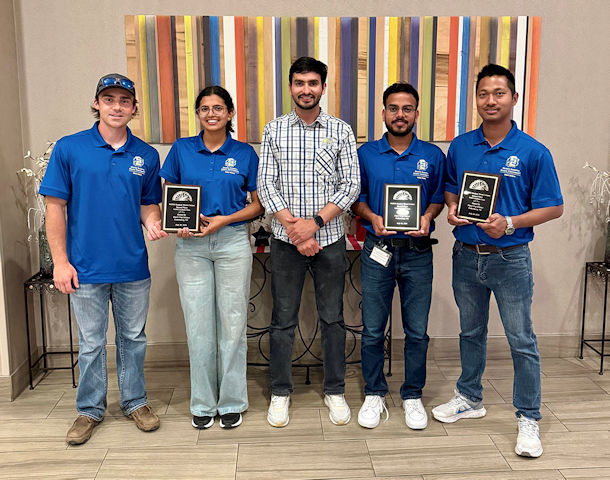
BROOKINGS, S.D. (9-21-26) — The South Dakota State University Weed Science graduate team placed second in the Western Society of Weed Science category at the North Central Weed Science Society and WSWS Joint Student Weed Contest, hosted by Bayer, July 29-30.
Students, representing both an undergraduate team and a graduate team, prepared for months studying weed identification, unknown herbicide identification, farmer problem-solving and recommendations, sprayer calibration and mathematical problems related to herbicide use and sprayer calibration.
This was the first time SDSU has prepared for and participated in this contest. Sachin Dhanda, assistant professor of weed ecology and the teams’ coach, said this contest provides students with valuable real-world experience beyond the classroom.
“It challenges them to apply their knowledge to practical weed management problems, strengthen their problem-solving skills and build confidence that will benefit them throughout their careers,” said Dhanda, a faculty member in the Department of Agronomy, Horticulture and Plant Science.
The competition also provides students with opportunities to network with university faculty, researchers, industry professionals and students from other universities.
Prajwal R. Shashishekhar, a student on the graduate team from Karnataka, India, focuses on research rooted in genetics and plant breeding. He said he is thankful for Dhanda and his teammates for making this experience possible.
“Participating in the weed contest was more than a competition — it broadened my perspective as an aspiring researcher and connected my background in genetics and plant breeding with practical weed science,” he said. “The experience strengthened my understanding of weed management and herbicide response and their importance to sustainable crop production.”
Another teammate, Ashish Chaudhary, is from Lumbini, Nepal. He said taking part in the weed contest was a great way to put their knowledge to the test outside of the classroom.
“While I’m proud of our second-place finish, the contest was a real reality check,” Chaudhary said. “It helped me realize how much more I need to learn across every part of weed science.”
Dhanda thanked Fritz Koppatschek from ABG Ag Services for organizing a practice session, as well as Klingbeil Endowed Department Head of Agronomy, Horticulture and Plant Science Karen Sanguinet, SDSU Extension Weed Specialist Eric Jones and SDSU Extension Weed Ecology Field Specialist Graig Reicks for their valuable support. He said he is extremely proud of both SDSU teams for their hard work, teamwork and strong performance.
“I look forward to seeing our students continue to learn, grow and represent SDSU in future competitions,” Dhanda said.
Members of the graduate team included:
- Ashish Chaudhary; Ph.D.; biological sciences; Lumbini, Nepal
- Hunter Mitchell; M.S.; plant science; Watertown
- Muskan Jakhar; M.S.; plant science; Haryana, India
- Prajwal R. Shashishekhar; Ph.D.; biological sciences; Karnataka, India
Members of the undergraduate team included:
- Brooke Koppatschek; senior; agricultural business; Toronto
- Evan Olson; senior; agronomy; Forbes, North Dakota
- Richard Meyer; senior; precision agriculture; White
- Samson Flakus; senior; agronomy; Aberdeen
About South Dakota State University
Founded in 1881, South Dakota State University is the state’s Morrill Act land-grant institution as well as its largest, most comprehensive school of higher education. SDSU confers degrees from seven different colleges representing more than 230 majors, minors and specializations. The institution also offers 39 master’s degree programs, 17 Ph.D. and two professional programs.
The work of the university is carried out on a residential campus in Brookings, at sites in Sioux Falls, Pierre and Rapid City, and through Extension offices and Agricultural Experiment Station research sites across the state. SDSU’s research expenditures for the 2025 fiscal year were more than $94 million. SDSU has a Doctoral University: High Research Activity designation on The Carnegie Classification of Institutions of Higher Education.
For more information: SDSU News • www.sdstate.edu
— From SDSU University Marketing and Communications