


BROOKINGS (11-18-26) — Thomas Wolfe wrote, “You can’t go home again.”
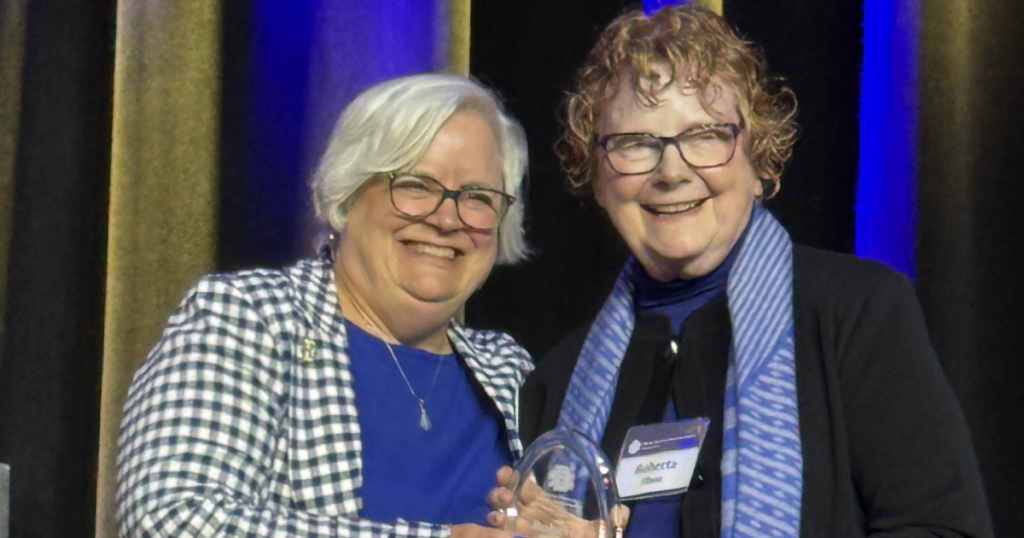
Fortunately for South Dakota State University, the words don’t apply to 1964 alumnus Roberta Olson, who served 20 years as the dean of the College of Nursing and received the college’s Living Legacy Award from current Dean Mary Anne Krogh at the East River Scholarship Reception Oct. 30.
Olson, the daughter of Robert and Inez Kinickrehm, grew up on a grain and cattle farm near Groton, where she learned the value of rising early, working hard and setting goals.
Those qualities served her well as dean, as well as when she came to the campus of South Dakota State College in fall 1960. Her nursing class was as big as her high school graduation class — 24. State was “huge” in the eyes of Olson, who lived in Wecota Hall, was a frequent visitor to Lincoln Library and played in the marching band.
Life on campus was a positive, if short-lived, experience.
Nursing students spent their first five quarters on campus and then hit the road for clinicals at hospitals in St. Paul and Minneapolis as well as Rapid City and Watertown. Living together in housing provided by the hospitals, the students developed close bonds with each other while classmates in Brookings became a memory.
The nursing students returned to SDSU in January 1964 to wrap up their schooling. State had switched from quarters to semesters. Graduation was in June on Sylvan Green.
“I remember walking across the stage, shaking hands with (school president) Hilton Briggs,” she said.
Early career centered in St. Louis area
Olson walked out of Brookings that day, not to return again for 30 years. Her first job was as a staff nurse with the Veterans’ Hospital, first in Fort Wayne, Indiana, and then St. Louis. From 1966 to 1968, she worked on a master’s degree in maternal-child nursing at Washington University in St. Louis while working part time as a pediatric nurse.
She would earn a master’s degree in 1968. In1984 she also completed her doctorate and was promoted to department head at Saint Louis University. In 1989, she moved to Kansas City, Kansas, to become associate dean for academic affairs until 1992.
By August 1992, Olson moved to become associate dean of academic affairs at the prestigious University of Texas Health Science Center in Houston.
Alma mater in need of a dean
Meanwhile, back in Brookings, the SDSU College of Nursing had struggled to find the right fit for the position since Carol J. Peterson moved from dean to central administration in 1987. In 1993, Evelyn Peterson was coordinator of graduate nursing programs. She had some advice for Carol Peterson (no relation), who was in charge of filling the dean’s position.
Carol Peterson remembers Evelyn Peterson telling her about Olson — an outstanding student who had become an associate dean in the Texas system.
Carol Peterson convinced Olson to come home. It didn’t require major arm twisting. She wanted to become a dean and wanted to be in the Midwest. “I had no idea it would be at SDSU. It was a real plum to be able to come back to SDSU,” Olson said.
In January 1994, Roberta and David Olson and their high school sons, Aaron and Daniel, packed their bags. Olson’s Houston colleagues considered her nuts to leave the warmth of Texas for the frozen tundra, but for Olson, it was home.
Olson didn’t take long to remake her new academic home. Carol Peterson said, “The college began to change positively immediately after Dean Olson took office.”
Put early emphasis on graduate program
Olson recalled the college had “excellent faculty and a really good pass rate on the NELEX RN licensing exam for undergraduates. They had strong students and a master’s program that was preparing students in nurse administration, clinical nurse specialist, nurse practitioners and nurse educators. (The college was) doing well, but we really needed to expand the number of graduates (undergraduate and graduate) and look ahead to doctoral education.”
Therefore, an early emphasis was the graduate program. “We needed more nurse educators,” Olson said.
The clinical nurse specialist track, which only had two or three students, was discontinued, and an emphasis was put on the nurse educator and nurse practitioner tracks.
Accelerated program begins in 2002
In addition, Olson and her leadership team met regularly with the employers of SDSU’s graduates — Avera, Sanford and Rapid City Regional (now Monument Health). “They indicated that they needed more clinical educators to onboard more new nurses. They knew that the nurse practitioner role was really taking off.”
It was really Norene Davis, who was the vice president for nursing at Avera, who asked in 1999, “Have you thought about an accelerated track for students who already have degrees?” Olson recalled. “When we had the dialog with the (South Dakota) Board of Regents, that went through fairly quickly. We put in a request to the regents in 2000. By 2002 we were ready to enroll in Sioux Falls. We got funding for that because of the shortage of nurses.”
Leadership style promoted stability
Olson never fully disconnected from her profession. In fact, she served as interim dean for 14 months in 2018-19 between Nancy Fahrenwald and current Dean Mary Anne Krogh.
At age 83, she continues to stay abreast of the field by attending district and state meetings of the South Dakota Nurses Association. Krogh said, “Dean Olson served as a trusted mentor when I stepped into the role of dean and continues to serve as a sounding board when thorny issues arise. I am a better dean because of her presence.”
As Olson looks back on her career, she said part of the reason for her success is how she approached situations. Rather than point the finger, she would ask, “Help me understand?” or say, “Let’s see what we can do to find a solution.”
That contributed to the stability she had in her leadership team. When Olson returned to SDSU in 1994, her team was Bill McBreen, head of nursing research and special services; Tim Gaspar, head of undergraduate nursing; and Marge Hegge, head of graduate nursing. “They oriented me to the whole process at SDSU. They were all with me for those critical first few years of my deanship.”
McBreen and Gaspar went on to take top administrative positions at Briar Cliff and Mankato, respectively, while Hegge was tapped to lead SDSU’s assessment office.
Hegge said, “Dean Olson was a talented leader who quickly connected with healthcare leaders across the state to address critical needs for nursing in all settings. She secured federal, state and private funds to advance the faculty, grow and expand programs and ensure students had access to the resources to help them succeed and enter the workforce prepared to meet the needs of patients, families and communities.
“She was a respected force on the SDSU leadership team and was a recognized expert in South Dakota healthcare. She raised the bar for the College of Nursing to launch it into the premiere nursing college it is today.”
About South Dakota State University
Founded in 1881, South Dakota State University is the state’s Morrill Act land-grant institution as well as its largest, most comprehensive school of higher education. SDSU confers degrees from seven different colleges representing more than 230 majors, minors and specializations. The institution also offers 41 master’s degree programs, 19 Ph.D. and two professional programs.
The work of the university is carried out on a residential campus in Brookings, at sites in Sioux Falls, Pierre and Rapid City, and through Extension offices and Agricultural Experiment Station research sites across the state. SDSU’s research expenditures for the 2026 fiscal year were more than $86 million. SDSU has a Doctoral University: High Research Activity designation on The Carnegie Classification of Institutions of Higher Education.
For more information: SDSU News • www.sdstate.edu
— From SDSU University Marketing and Communications