

BROOKINGS (10-9-26) — Swine producers, researchers and other industry professionals from across the region gathered for the 10th annual South Dakota State University Swine Day on Sept. 29 at Club 71 in Dana J. Dykhouse Stadium.
The event was hosted by SDSU Extension in collaboration with the SDSU Department of Animal Science and the Department of Agricultural and Biosystems Engineering.
“I think Swine Day has been a fantastic opportunity to be able to get that interaction between our staff and our students here and the industry,” said Rafe Royall, assistant professor and SDSU Extension swine specialist. “It’s an awesome opportunity for us to present the best of ourselves to the folks that we’re really here to serve as research and extension personnel.”
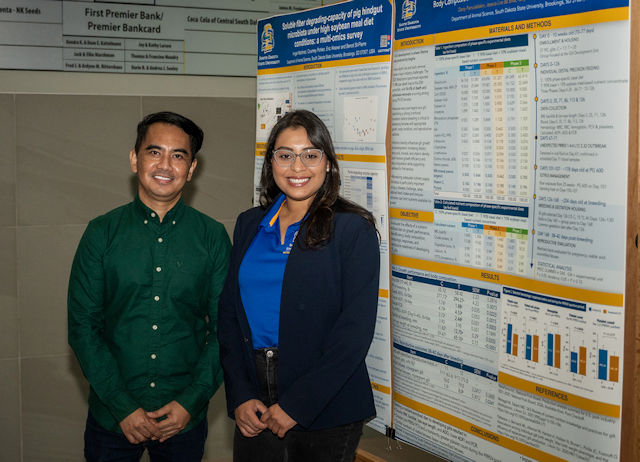
The day started with a student poster competition where undergraduate and graduate students presented their research to attendees. Following the poster competition, Michael Gonda, interim head of the Department of Animal Science, welcomed guests and spoke about department initiatives. After the welcome, Royall presented about the National Swine Health Strategy, followed by faculty Crystal Levesque and Eric Weaver, who presented about swine research happening currently at SDSU.
The afternoon session included swine research update presentations from Ph.D. students Katlyn McClellan, Foreman Atoo and Jessica Lira, and then an “Industry update from an economist’s perspective” with Mike Minor and Jordan Reker, risk managers with Professional Ag Marketing.
The day concluded with a keynote presentation by Dr. Joel Nerem, a veterinarian at Pipestone. His topic focused on the economics of infectious diseases in wean-to-market pigs and the impact biosecurity in wean-to-market farms has on reducing those infections.
“Health has a major impact on the profitability of pig farmers, and it has a major impact on pig welfare, right? So, our goal is always to try and maximize pig health and maximize our customers’ profitability,” Nerem said.
Nerem said Swine Day at SDSU is important to local producers and the swine industry overall in South Dakota.
“SDSU does a lot of really great work in creating scientists and in creating future veterinarians and in producing future producers, future pig farmers, and so it’s important that with a program like they have here, it’s important to highlight the accomplishments of those students, as well as bring in folks that can talk about where the industry is and where it’s going,” he said.
There were three categories in the poster competition for undergraduate, master’s and Ph.D. students. Winners received scholarships in various amounts.
Ph.D. Division
• First: Darcy Pamulaklakin – “Nutrient-enriched gilt development diet improved growth efficiency and body composition during a confirmed PRRSv 1-4-4 L1C.5.32 outbreak”
• Second: Jessica Lira da Silva – “Effects of dietary copper source in nursery and grow-finish pigs”
Master’s Division
• First: Kynna Crawford – “A new approach to screening ingredients affecting early feed intake: evaluating the efficacy of a Plackett-Burman design”
• Second: Courtney Pohlen – “Growth performance effects of dietary intact protein or synthetic amino acids on early grower pigs”
Undergraduate Division
• First: Karin Sweeter – “Defining standardized ileal digestible histidine to lysine ratio requirements in 18- to 50-lb nursery pigs”
Swine Day at SDSU was made possible with the support from the South Dakota Pork Producers Council, XFE Products, Farm Credit Services of America and Philbro Animal Health Corporation.
About South Dakota State University
Founded in 1881, South Dakota State University is the state’s Morrill Act land-grant institution as well as its largest, most comprehensive school of higher education. SDSU confers degrees from seven different colleges representing more than 230 majors, minors and specializations. The institution also offers 39 master’s degree programs, 17 Ph.D. and two professional programs.
The work of the university is carried out on a residential campus in Brookings, at sites in Sioux Falls, Pierre and Rapid City, and through Extension offices and Agricultural Experiment Station research sites across the state. SDSU’s research expenditures for the 2025 fiscal year were more than $94 million. SDSU has a Doctoral University: High Research Activity designation on The Carnegie Classification of Institutions of Higher Education.
For more information: SDSU News • www.sdstate.edu
— From SDSU University Marketing and Communications