

BROOKINGS (11-2-26) — NASA officials have picked teams from South Dakota State University and Brookings High School as finalists in its Human Exploration Rover Challenge.
This is the second year that SDSU has entered the contest. Last year’s team finished second in the international contest, which is held in Huntsville, Alabama, home to NASA’s Marshall Space Flight Center. This is the first time for BHS to enter this, or any, space contest. The team is being mentored by the SDSU squad.
Todd Letcher, an SDSU mechanical engineering professor and faculty adviser for the SDSU team, said, “We’re really excited to have two teams going from Brookings to Huntsville. The group we have from the high school is very committed, and they’re willing to go the extra mile.
“I know our college team is determined to finish one place higher this year. Plus mentoring high school students gives them a chance to develop leadership skills early in their career.”
After last school year’s successful entry, there was no question that SDSU would be fielding a team again.
BHS team forms over the summer
The creation of a Brookings High School team can be credited to Letcher and career-oriented senior Ian Coverstone. Until this year, Coverstone’s extracurricular activities have centered around the arts. However, his career ambition is to become an aerospace engineer. With his final year of high school approaching, he decided he needed to wet his feet in that area.
Coverstone’s brother, Tanner, is a graduate student in mechanical engineering at SDSU and was aware of Letcher’s involvement in NASA contests.
Ian Coverstone reached out to Letcher in July. A week later he heard back from Letcher about the Human Exploration Rover Challenge, which has categories for university and high school/middle school teams. In early August, Coverstone reached out to his friends. They liked the idea of creating a team and accepted an invitation to attend the start-of-school space club meeting at SDSU.
The eight members began writing a contest proposal at the beginning of September and had it submitted by the Sept. 17 deadline.
The SDSU team also faced a Sept. 17 deadline. Even though the school had a HERC finalist in 2025-26, there is only one returning member. The team does have additional experienced guidance through faculty adviser Letcher and graduate student adviser Nick Sieler, who both served in those roles last year.
Facilities a major requirement for teams
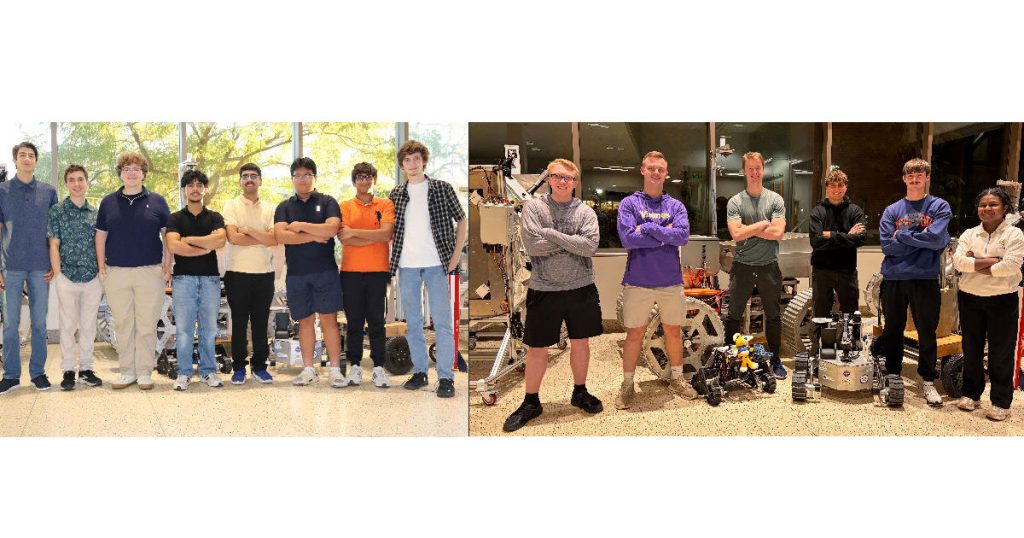
SDSU team members are freshmen Bryce Heflin, of Madison, and Caelen Condon, of Marshall, Minnesota; sophomores Nick Joy, of Eagan, Minnesota, Hannah Marie Kiki, of Papua New Guinea; Joseph Row, of Winona, Minnesota; and Ashton Squires, of Tracy, Minnesota. All are mechanical engineering majors.
The BHS team members are seniors Coverstone, Corbyn Penner, Navneeth Rao, Brycen Caylor, Shaurya Sehgal, Tyler Schulte and Murtadha Jodhari; and junior Louis Liu.
While the SDSU team could use last year’s proposal for reference, the BHS squad was working from scratch. Judging of the proposals is based on facilities/equipment, 40%; project plan, 30%; safety plan, 15%; design, 10%; and introduction, 5%. Sieler summarized, “Can you do it, and are you going to be safe?”
With the BHS team working out of SDSU facilities, it was in good shape for those points. Coverstone added that the team does have access to 3D printers and other equipment at the high school’s Career and Technical Education building.
Contest: half mile, 10 obstacles, 12 minutes or less
For both divisions, the objective is to have their battery-powered, remote-controlled vehicle complete a half-mile course that contains 10 obstacles within 12 minutes. In addition, the vehicles must be able to receive radio transmissions and execute commands based on the signal received.
The commands will direct the vehicle to move to a certain area, apply the correct filter and take a time-stamped photo with commands to be sent every 30 seconds.
The task for the 2027 contest, which is April 21-24, is new this year. However, the course is unchanged. Having video and student comments from the 2026 contest will help in designing this year’s SDSU entry, Sieler said. He noted that vehicle completed seven of the 10 obstacles in April 2026.
“We’re going to be creating a more versatile drivetrain that can complete all obstacles,” which includes traversing a 21-foot incline with a 20-degree slope, Sieler said.
Rovers must be able to fit in a 2.5-foot square cube. The SDSU team is aiming for a rover that will weigh 20 pounds or less to earn bonus points. The contest allows rovers to weigh up to 60 pounds.
Mentoring has its limits
High school teams are allowed to buy a commercial drivetrain. However, Sieler said, “Since they are working with us, we will help them build the entire drive train from scratch.” The key word is help. “We can show them how to run a machine in the lab. They have to build the entire thing themselves,” Sieler said.
In addition to get some great hands-on engineering experience, the BHS seniors are able to use the project as their capstone experience, which is a new graduation requirement in Brookings. Coverstone said, “Counting the contest as our capstone project was a nice coincidence, but that is not the reason we formed this team.”
The team has already met its first goal — to be selected as a finalist.
Coverstone said, “Now the goal is to get first place and try to get as many subawards as possible.” In addition to overall point placement, there are 12 others awards, such as safety, innovation and team spirit.
The SDSU team has the same goals. “We still have a little more longing for that first-place award” after finishing second this April, said Nick Joy, the lone returning team member. “This year we’re hoping to take down the champion.”
Challenges for BHS includes finances
SDSU is one of 27 finalists in the university remote control division. Others include 2026 champ University of Alabama in Huntsville and engineering blueblood Virginia Tech as well as a school from Canada and six teams from five Latin American countries.
BHS is one of 13 teams in the middle/high school remote control division, including magnet schools and private academies as well as schools from four foreign countries.
Joy said, “I’m a very competitive person. Let’s fight it out and see who gets first place.” He added he also is excited by the teamwork the contest produces. “The late nights, struggling to stay up late, working toward something makes you really feel like an engineer.”
Coverstone said, “The competition is all over the world. We’re excited to be able to go out and show Brookings’ talents on a broader stage.”
A challenge the BHS team faces is finances. The project is expected to cost $8,000 with $6,000 of that being for travel and lodging. “We’re looking for sponsors and donations and have opened a GoFundMe page. I’m confident in our team, and we can beat that challenge, too,” Coverstone said.
The SDSU team will be funded by the South Dakota Space Grant Consortium and the SDSU Aerospace Club.
About South Dakota State University
Founded in 1881, South Dakota State University is the state’s Morrill Act land-grant institution as well as its largest, most comprehensive school of higher education. SDSU confers degrees from seven different colleges representing more than 230 majors, minors and specializations. The institution also offers 41 master’s degree programs, 19 Ph.D. and two professional programs.
The work of the university is carried out on a residential campus in Brookings, at sites in Sioux Falls, Pierre and Rapid City, and through Extension offices and Agricultural Experiment Station research sites across the state. SDSU’s research expenditures for the 2026 fiscal year were more than $86 million. SDSU has a Doctoral University: High Research Activity designation on The Carnegie Classification of Institutions of Higher Education.
For more information: SDSU News • www.sdstate.edu
— From SDSU University Marketing and Communications