

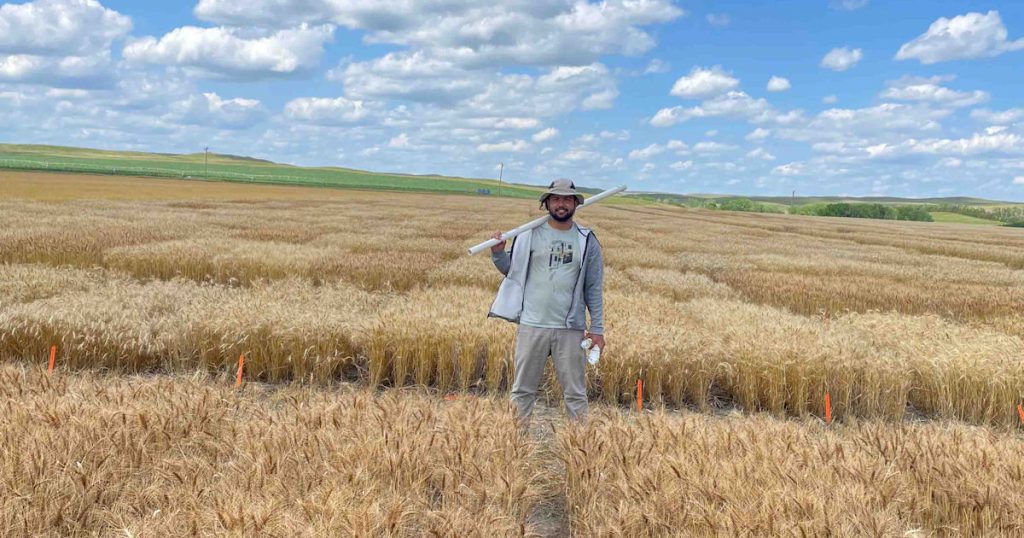
BROOKINGS (11-12-26) — Graduate student Subash Thapa, who studies wheat breeding and genetics at South Dakota State University, is reaping a bountiful harvest of honors in his fourth year of the program.
In recent months, Thapa has received a $20,400 Global Wheat Health Alliance Seed Grant, participated in an international phenotyping program in Ghana, won an Innovation Sprint quiz competition and received a $1,000 Phi Kappa Phi Love of Learning Award. Together, the honors reflect his growing work at the intersection of wheat breeding, plant pathology and emerging phenotyping technologies.
Thapa’s mentor in his doctoral studies is SDSU professor Sunish Sehgal.
“Receiving an international research grant as a Ph.D. student speaks to Subash’s creativity, initiative and ability to translate innovative ideas into practical research solutions. His work in plant phenotyping is helping connect advanced technologies with real-world challenges in wheat breeding and disease resistance.” Sehgal said.
Only U.S. student selected
Thapa recently returned from Accra, Ghana, where he was one of 35 participants and the only student from the United States, selected from a pool of more than 400 applicants for the Phenotyping Innovation Sprint 2026: Phenomics in Plant Breeding, Oct. 10-11.
The Innovation Sprint was convened by the International Plant Phenotyping Network and the African Plant Breeders Association and was fully funded by the Novo Nordisk Foundation. Thapa’s travel, accommodation and registration were supported through the award.
The two-day program brought together researchers, plant breeders, technology specialists and other scientists for hands-on training and discussion around advanced plant phenotyping. Participants worked with topics including experimental design, data analysis and hands-on data generation using advanced phenotyping technologies.
The Innovation Sprint preceded the ninth International Plant Phenotyping Symposium, held Oct. 12-16 in Accra. The symposium drew participants from 40 countries, giving Thapa an opportunity to interact with a broad international community working in plant phenotyping and crop improvement.
“For me, this experience was especially valuable because much of my doctoral research at SDSU focuses on integrating plant breeding, plant pathology, high-throughput phenotyping, computer vision and artificial intelligence to improve how we measure disease resistance in wheat,” Thapa said.
Topped other students in Innovation Sprint quiz
Thapa also won a quiz conducted on the second day of the Innovation Sprint. The competition included the 35 selected participants and covered topics discussed during the workshop as well as broader questions related to plant phenotyping.
“I was also fortunate to win the quiz conducted on the second day of the Innovation Sprint, which was a fun additional recognition during the program,” Thapa said.
“Beyond the formal training, one of the most valuable parts of the trip was the opportunity to interact with researchers and scientists from around the world who are working on plant phenotyping and crop improvement. It gave me a broader perspective on how the technologies we are developing at SDSU could potentially be applied in breeding programs and agricultural systems beyond the United States,” Thapa said.
Among those technologies is WheatAI, an AI-powered web application designed to speed the work of wheat breeders and make image-based phenotyping tools more accessible to researchers, agronomists and growers.
The platform uses artificial intelligence to analyze ordinary digital images for several wheat traits. Among the applications Thapa is working on are automated assessments of Fusarium head blight severity in the field and Fusarium-damaged kernels after harvest.
Part of inaugural cohort for wheat alliance
That work is also at the center of Thapa’s $20,400 seed grant from the Global Wheat Health Alliance. His project, “Field-Calibrated Smartphone Phenotyping of Fusarium Head Blight,” will expand the research beyond SDSU through collaboration with Xinyao He, a wheat geneticist and pathologist at the International Maize and Wheat Improvement Center, known as CIMMYT, in Mexico.
Through the project, Thapa plans to further evaluate and generalize his Fusarium head blight and Fusarium-damaged kernel estimation models across different environments, wheat materials and smartphone imaging conditions. The goal is to move the technology closer to broader use in wheat breeding programs.
“This award is particularly exciting to me because it provides an opportunity to take some of the research and technologies we have been developing at SDSU and evaluate them in an international wheat-breeding environment,” Thapa said.
“Being selected as part of the inaugural cohort of Global Wheat Health Alliance Seed Grant recipients is a tremendous honor. I am very grateful for the opportunity to represent SDSU through this work,” Thapa said.
Also honored by local Phi Kappa Phi chapter
Thapa’s recent recognition also includes the Phi Kappa Phi Love of Learning Award, which provides $1,000 to support his continued academic and professional development. He plans to use the award to help support participation in scientific conferences and symposiums where he can present his research, learn about new developments in his field and connect with other scientists.
The award adds a local recognition to a series of international opportunities that Thapa said are helping him develop as both a researcher and plant breeder.
Thapa, a native of Nepal, expects to complete his doctorate in May 2027. After graduation, he hopes to continue working in the seed industry in wheat breeding, disease resistance or related agricultural research.
About South Dakota State University
Founded in 1881, South Dakota State University is the state’s Morrill Act land-grant institution as well as its largest, most comprehensive school of higher education. SDSU confers degrees from seven different colleges representing more than 230 majors, minors and specializations. The institution also offers 41 master’s degree programs, 19 Ph.D. and two professional programs.
The work of the university is carried out on a residential campus in Brookings, at sites in Sioux Falls, Pierre and Rapid City, and through Extension offices and Agricultural Experiment Station research sites across the state. SDSU’s research expenditures for the 2026 fiscal year were more than $86 million. SDSU has a Doctoral University: High Research Activity designation on The Carnegie Classification of Institutions of Higher Education.
For more information: SDSU News • www.sdstate.edu
— From SDSU University Marketing and Communications