

BROOKINGS, S.D. — Oct. 9, 2026 — There’s something basic about how the cells in your body work that the scientific community doesn’t fully understand.
It’s called macropinocytosis. That’s an important process by which cells take in nutrients and other molecules from the fluids around them.
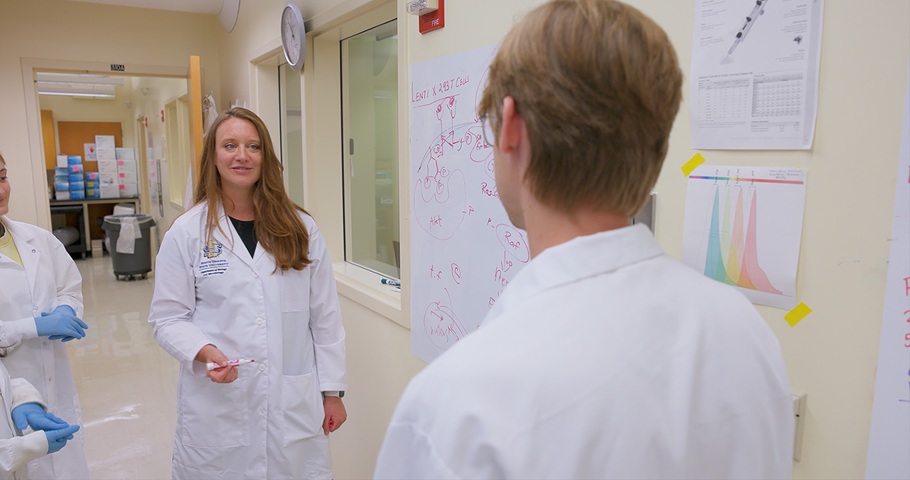
Macropinocytosis has barely been studied. But in a lab tucked away in South Dakota State University’s Avera Health and Science Center, a research team is making breakthroughs.
Natalie Thiex is a graduate coordinator of the human biology master’s program and a cell biology researcher at SDSU.
“I think people would be surprised when they find out just how little we know about how macropinocytosis works,” she said.
Thiex and her lab team received a $2 million R01 grant from the National Institutes of Health to fill in those gaps. It’s research that could have wide-ranging applications, including for cancer treatment and basic immune function.
Cell drinking vs. eating
In the human body, cells can take up the fluid around them while they float in the bloodstream or in a tissue.
Thiex refers to it as “cell drinking.” With macropinocytosis, the cells slurp up a lot.
“One of my graduate students would put up a picture of a 7-Eleven Big Gulp on his presentations to get the idea across,” she said.
When macrophages, a type of white blood cell, drink something up from the environment around them, they take a big gulp.
“They are taking up nutrients and removing debris or maybe even clearing up inflammation,” Thiex said.
Macrophages are the first responders of the body’s immune system. They’re most famous for phagocytosis — a process by which they “eat” and neutralize an invading pathogen.
Phagocytosis is better understood. A receptor on the cell’s surface binds to a target and identifies it as something that needs to be removed. The cell’s membrane envelops the target and brings it and a fluid-filled bubble into the cell where it can be digested. Phagocytosis involves taking in solid particles and is cell eating instead of drinking.
With macropinocytosis, scientists have no idea how a cell knows there’s something in the surrounding fluid that would be good to drink.
“It happens spontaneously, and some cells like macrophages do it all the time,” Thiex said.
It’s especially surprising since macropinocytosis takes a lot of orchestration within a cell. The cell structure pushes up the membrane from below, creating ruffles on the cell’s surface. The ruffles collapse and capture a bubble of fluid — called a macropinosome — and bring it into the cell.
“We are very curious to know how a cell organizes its membrane like that without any target to scaffold it.” she said.
Up to now, it was assumed macrocytosis was a different version of phagocytosis, but an experiment in the Thiex lab shows that’s not true.
Glowing answers
It starts with guide RNA and a special protein called Cas9. The lab can essentially order a tiny, 15-microliter tube filled with 80,000 different guide RNAs. Those target different parts of the genome.
“We have a dish of macrophages in a culture, and each cell has a different gene disruption in it. We don’t know which has which gene disruption, but we do know that if it happens to be critical to macropinocytosis, we expect the cell to not be able to make a macropinosome very efficiently,” she said.
The lab then splashes the dish with a fluorescent dye and waits 30 minutes. Thiex or a lab worker will wash off the excess dye and sort the cells by how fluorescent they are. The cells that can’t perform macropinocytosis very well will have low fluorescence, meaning they didn’t drink up much of the dye around them.
“We can sort the low drinkers into one tube and the high fluorescent cells into another one. So those low drinkers, they would be the cells that have genes disrupted that are required for macropinocytosis,” she said.
The lab then analyzes the low drinkers to see which guide RNAs they were impacted by and which genes those guide RNA disrupted. That can provide a clue as to which parts of the genome control macropinocytosis.
Three new discoveries
The Thiex lab has already busted through a few assumptions held by the larger scientific community. First, the solute many people were using to study macropinocytosis was actually being taken into the cell through a different process, not macropinocytosis.
“That’s probably one of the reasons why people weren’t able to get much traction understanding the macropinocytosis process, especially in macrophages,” Thiex said.
Second, macropinocytosis doesn’t use the same genes to work as phagocytosis. In fact, they’ve found that some of the machinery used to activate phagocytosis actually inhibits macropinocytosis.
And lastly, the lab identified a lipid in the cell membrane that seems to play a big role in macropinocytosis. With the R01 grant, the Thiex Lab will further investigate the PI3P lipid and how it works.
Not only could this research build a foundational understanding of how cells work, but it could also be a new pathway for disease treatments.
Thiex said cancer cells need a lot of nutrients to support their rapid, out-of-control growth. To take in a lot of nutrients, these cells kick macropinocytosis into high gear.
Understanding macropinocytosis means researchers could learn how to inhibit it and stop cancer cell growth. It could also help prevent other out-of-control reactions in the human body, such as during an autoimmune attack.
“Sometimes, you don’t know how your research is going to be useful, but almost all of our medical knowledge has come from somebody just trying to figure out how cells work. Almost every new medicine comes from understanding a basic molecular process and then figuring out a way to inhibit or force it,” Thiex said.
The R01 grant will fund the lab for four years, including the salaries of graduate and undergraduate students gaining hands-on experience performing these experiments.
“It will help us finish our research and experiments related to this topic and then publish and disseminate the knowledge we learned to the whole world,” Thiex said.
Starting on the COBRE launchpad
Thiex was one of the original research project leaders for SDSU’s Center of Biomedical Research Excellence, or COBRE, called BioSNTR II and funded by the National Institutes of Health.
Daniel Scholl is the vice president for research and economic development at SDSU.
“The NIH COBRE Center, BioSNTR II, has been a tremendously effective development program for SDSU faculty,” he said. “Natalie Thiex’s new NIH-funded work on how cells behave will help scientists better understand how to identify and treat diseases. BioSNTR II provided an opportunity, and Dr. Thiex built on it.”
SDSU is the only educational institution in South Dakota with one of these centers.
“COBRE helps faculty members with an on-ramp into research. They can build up their labs and research capacity and get key publications out,” said Adam Hoppe, an SDSU professor and the associate dean of research in the College of Natural Sciences.
From the research and publications supported by the COBRE, Thiex and other former project leaders have gone on to receive R01 grants.
“R01 grants are sort of a membership card for biomedical research. It shows high research performance and the scale of their work. You’re running a really strong research lab,” Hoppe said.
Thiex is now the third SDSU COBRE researcher to receive an R01 grant. There are several current SDSU researchers performing research under COBRE, so she won’t be the last.
About South Dakota State University
Founded in 1881, South Dakota State University is the state’s Morrill Act land-grant institution as well as its largest, most comprehensive school of higher education. SDSU confers degrees from seven different colleges representing more than 230 majors, minors and specializations. The institution also offers 39 master’s degree programs, 17 Ph.D. and two professional programs.
The work of the university is carried out on a residential campus in Brookings, at sites in Sioux Falls, Pierre and Rapid City, and through Extension offices and Agricultural Experiment Station research sites across the state. SDSU’s research expenditures for the 2025 fiscal year were more than $94 million. SDSU has a Doctoral University: High Research Activity designation on The Carnegie Classification of Institutions of Higher Education.
For more information: SDSU News • www.sdstate.edu
— From SDSU University Marketing and Communications