

BROOKINGS (11-2-26) — Two South Dakota State University researchers played key roles in a five-year, multistate livestock reproduction initiative recently recognized with the 2026 Excellence in Multistate Research Award.
The award honors the W4112 project, which ran from Oct. 1, 2021, through Sept. 30, 2026. The nationwide collaboration brought together scientists from land-grant universities across the country to improve reproductive performance in cattle, sheep and other ruminant livestock. SDSU faculty members Jessica Nora Drum and Manuel Alexander Vasquez-Hidalgo were among the contributors.
The project addressed challenges affecting reproductive efficiency, animal health and producer profitability. Research objectives included improving understanding of animal reproduction, examining how management and environmental conditions affect fertility, advancing research on pregnancy and fetal development, investigating factors that influence male fertility and preparing future livestock scientists.
Drum, assistant professor in the Department of Animal Science and SDSU Extension reproductive physiology specialist, has served as chair of the W4112 committee for the past two years. In that role, she coordinated activities among participating institutions and helped facilitate research collaborations across the country.
At SDSU, Drum’s research has focused on improving fertility and pregnancy success in beef cattle. Her team has studied estrous synchronization protocols, which are management tools that allow producers to bring groups of cows into heat at the same time for more efficient breeding through artificial insemination.
“Our team has conducted research examining estrus expression, follicular development, reproductive tract microbiology and fertility outcomes,” Drum said. “We have also investigated maternal nutrition, embryo-maternal communication and factors influencing pregnancy-associated glycoproteins, which are important indicators of placental function and pregnancy establishment.”
Among the team’s findings was a better understanding of how cows respond to the 7&7 Synch breeding protocol. Researchers found variation in the timing of estrus among cows, creating opportunities to improve artificial insemination timing and potentially increase pregnancy rates.
Additional SDSU research examined proteins associated with pregnancy and placental function. The work identified differences between cows carrying male and female fetuses, helping researchers better understand pregnancy establishment and fetal development.
“Receiving this award is a tremendous honor because it recognizes the impact of collaborative science,” Drum said. “Many of the reproductive challenges facing livestock producers today are too complex for any single institution to address independently.”
Vasquez-Hidalgo, assistant professor in the Department of Veterinary and Biomedical Sciences, has participated in the multistate group for the past two years. His research contributes to project goals focused on reproductive function, fetal development and student training.
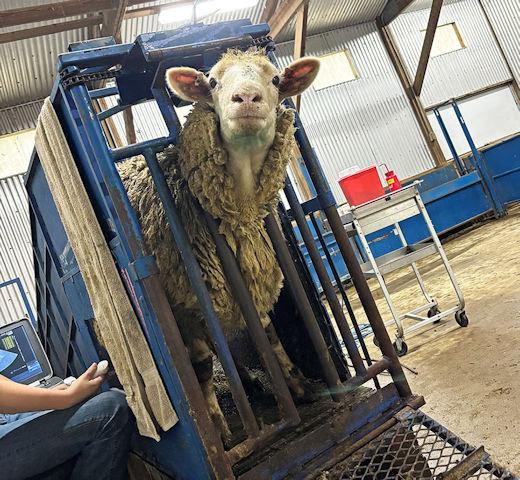
At SDSU, Vasquez-Hidalgo’s team has investigated how management practices during pregnancy affect fetal development in sheep.
“Our research showed that shearing pregnant ewes during mid-gestation improves blood flow from the mother to the fetus and increases fetal size,” Vasquez-Hidalgo said. “We are continuing this work and several other developmental programming studies with collaborators at SDSU and other universities.”
His research has resulted in peer-reviewed publications and presentations at national scientific meetings. According to Vasquez-Hidalgo, the value of the project extends beyond individual studies.
“The objectives of the group directly or indirectly translate to applied research that provides additional information for producers,” he said. “That information can include new management strategies, nutritional effects on livestock reproduction, fetal developmental programming, and offspring health and performance.”
In addition to their research contributions, SDSU played a leadership role in the project by hosting the annual W4112 meeting in Brookings in May 2026. The event brought reproductive scientists from across the country to South Dakota and provided opportunities to strengthen existing partnerships and explore new research collaborations.
Through W4112, Drum has worked with researchers at institutions including the University of Missouri, the University of Wisconsin-Madison and the University of Wyoming. Those partnerships have led to joint research projects, scientific publications and opportunities for graduate student training.
For Vasquez-Hidalgo, the award also reflects the mentorship and professional relationships fostered through the project.
“Being a new member, it’s an honor to be part of this group,” Vasquez-Hidalgo said. “As a student, I looked up to many of these scientists and the groundbreaking research they conducted. Now, I’m grateful to work alongside them, develop collaborations and contribute to the group’s overall objectives.”
Student involvement has remained a cornerstone of the effort. Graduate and undergraduate students have contributed to research projects, presentations and publications while gaining hands-on experience in animal reproduction and livestock production.
“The publications, student training opportunities and research innovations generated through W4112 are a testament to the value of these long-term partnerships,” Drum said. “The award highlights the importance of the multistate research system in fostering collaboration, sharing expertise and resources and accelerating scientific discovery.”
Through the W4112 project, SDSU researchers continue to contribute discoveries aimed at improving reproductive success, animal health and productivity in livestock systems while preparing the next generation of agricultural scientists. Learn more about this project on the W4112 website.
About South Dakota State University
Founded in 1881, South Dakota State University is the state’s Morrill Act land-grant institution as well as its largest, most comprehensive school of higher education. SDSU confers degrees from seven different colleges representing more than 230 majors, minors and specializations. The institution also offers 41 master’s degree programs, 19 Ph.D. and two professional programs.
The work of the university is carried out on a residential campus in Brookings, at sites in Sioux Falls, Pierre and Rapid City, and through Extension offices and Agricultural Experiment Station research sites across the state. SDSU’s research expenditures for the 2026 fiscal year were more than $86 million. SDSU has a Doctoral University: High Research Activity designation on The Carnegie Classification of Institutions of Higher Education.
For more information: SDSU News • www.sdstate.edu
— From SDSU University Marketing and Communications