

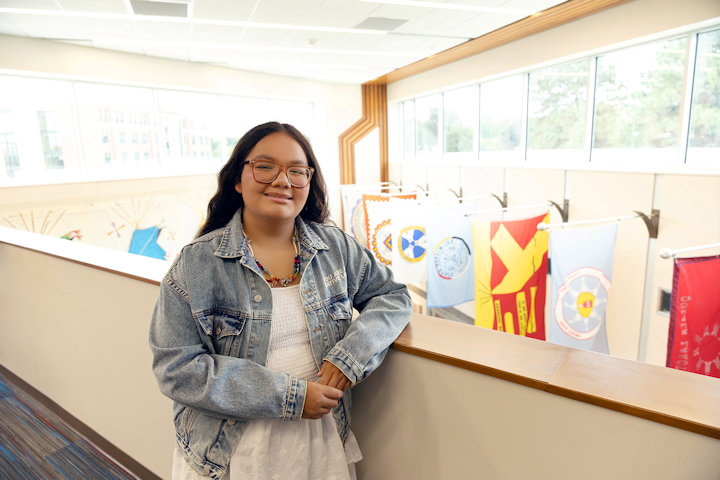
BROOKINGS (11-3-26) — Quinn Benoist from Eagle Butte is an enrolled member of the Cheyenne River Sioux Tribe. She’s Miniconjou and Hunkpapa Lakota and a descendent of the United Keetoowah Band of Cherokee Indians of Oklahoma.
She’s also a Wokini Scholar and a sophomore at South Dakota State University studying sport management, with a leadership and management of nonprofit organizations minor.
When looking for a university, Benoist said she had two priorities, both connected to the communities she grew up with.
Built-in Native community
“What mattered to me the most was having a Native community. That’s what brought me here over other South Dakota schools,” Benoist said.
SDSU has an American Indian Student Center in the heart of its Brookings campus.
“Other Native centers weren’t even a center, just a room in their student union, or they felt pushed off to the side. Here, it felt like we were a part of everything,” she said.
A scholarship through SDSU’s Wokini Initiative sealed the deal. The university offers Wokini scholarships to students who are tribally enrolled or have descendancy through a federally recognized tribe in the U.S.
The fact that the yearly scholarship can last up to five years was a plus.
“I liked the fact that it continues on to your master’s program. I plan on getting my master’s, and I would like to get it here, so that added to my decision,” Benoist said.
In addition to the scholarship, the Wokini Initiative offers ways to build community on campus between Native students, such as through a monthly shared meal and several Indigenous student organizations.
She also has access to academic support like working with Marisa Hare, a student success adviser with the American Indian Student Center, who was also a sport management major at SDSU.
Benoist talks up all of that to prospective students as a student ambassador. At the Black Hills Wacipi (Powwow) in October, she joined other Jackrabbits to talk with future students about her experience at SDSU.
“When I table, I talk mostly about being a Native student. I talk about the Wokini Initiative, the opportunities at SDSU and I especially highlight the American Indian Student Center. I want to make sure students know that there’s a place for them here,” Benoist said.
Finding a strong Native community was one of her priorities. Her other was finding the right academic program.
Community through sport
Benoist said she’s been around sports all her life. Her parents were both coaches, and most of her family members coached or played a sport while she was growing up.
Although she didn’t play much herself, she found a home on the sidelines. She would help with the books and with facilitating setup and teardown before and after games.
“I really enjoyed the opportunity to be a part of providing an opportunity to students and the chance to give back to the community that has helped shaped who I am. Sports are huge on the reservation, and I wanted to show and prove that it’s just as important to help organize and the overall roles of the activities and athletic department at my school,” she said.
Benoist has an appreciation for behind-the-scenes work.
“There is so much preparation that goes unnoticed for each activity that’s hosted. School activities and athletics play a huge part in our communities where everyone feels connected. I wanted to excel in that part of athletics and show that you don’t have to be the best athlete per say to find your place in the game. It’s about making connections and positive impacts for others and giving back.”
Sports are a big part of her family and her community. Benoist has attended the Lakota Nation Invitational every year since she can remember and participated in multiple events. The Lakota Nation Invitational is one of the largest high school basketball tournaments in the nation, but also offers a wide range of sports, culture and educational events for everyone in Rapid City every December.
In the awe of the tournament, Benoist knew this is where her calling was. How to get there came next.
Benoist knew she wanted to major in sport management. She went looking for a top-notch program that offered a strong sense of community.
SDSU had a Division 1 athletics program and a sport management curriculum that stood out from others thanks to its wealth of real-world opportunities.
“SDSU sports management classes are very closely intertwined with our athletics department. In a lot of our classes, we are given the option to help with teams, go volunteer at games and get that hands-on experience,” she said.
While a freshman, she volunteered at the Summit League basketball tournament in Sioux Falls. It gave her a direct opportunity to see how a conference ran and participate in the logistics of it.
“That was really valuable to me, especially as a freshman, and I know I wouldn’t be able to get that type of opportunity at a different school,” she said.
Benoist’s ultimate goal is to work in women’s basketball at the college or professional level. SDSU and its Sport and Recreation Management Club are a steppingstone to those sidelines.
Benoist and other female students in the club convened to establish a Women in Sports Committee under the club.
“We get together every month or so and talk about what opportunities there are to help women in sports, but also to talk about professional development and how women in sports can be better represented in the club overall,” she said.
Outside of SDSU, Benoist is a founding member of the Cheyenne River Sioux Tribe Youth Council. She is also a member of SDSU’s American Indian Student Association, public relations chair of SDSU’s Advancing Indigenous Science and Engineering Society and a sister of the Chi Omega sorority.
Benoist joined the university with two “built-in” communities that reminded her of home. She’s now taken full advantage of the opportunities available at SDSU to get more involved on campus and in the community.
About South Dakota State University
Founded in 1881, South Dakota State University is the state’s Morrill Act land-grant institution as well as its largest, most comprehensive school of higher education. SDSU confers degrees from seven different colleges representing more than 230 majors, minors and specializations. The institution also offers 41 master’s degree programs, 19 Ph.D. and two professional programs.
The work of the university is carried out on a residential campus in Brookings, at sites in Sioux Falls, Pierre and Rapid City, and through Extension offices and Agricultural Experiment Station research sites across the state. SDSU’s research expenditures for the 2026 fiscal year were more than $86 million. SDSU has a Doctoral University: High Research Activity designation on The Carnegie Classification of Institutions of Higher Education.
For more information: SDSU News • www.sdstate.edu
— From SDSU University Marketing and Communications